Carroll Ban Lyrics
Jim McCannMusic Video
Carroll Ban Lyrics
’Twas in the town of Wexford they sentenced him to die,
And in the town of Wexford they built his gallows high.
And on a summer’s morning while gently beamed the dawn,
Upon their cruel gibbet they hung my Carroll Bán.
[Traditional verse omitted by the artist:]
Oh! he was true and loyal, Oh! he was proud and fair,
And only nineteen summers shown on his golden hair
And when his gallant brothers had grasped the pike in hand,
Where the green flag streamed the fairest, he stood for native land.
[Traditional verse omitted by the artist:]
I saw him cross the heather with his bold company
And from the rising hillside he waved his hand to me;
Then on my wild heart settled a load of woe and pain,
Mo bhron it's throbbing told me we'd never meet again.
He fought the Saxon foeman by Slaney’s glancing wave,
But brutal strength o’erpowered the gallant and the brave.
And in the flight that followed that day of misery,
Sore wounded was he taken, O’Carroll Bán mo chroí.
O fhior ghear that ever I saw that dreadful sight,
His locks all damply hanging and his cheeks so deathly white.
Small wonder that my ringlets had changed from gold to grey,
Or if the blessed hand of God had taken my life away.
They say the pride of England is contained in her past,
And my poor country, long oppressed, may soon be free at last,
Small matter if my country’s free if I have lost my love,
My land a nation in the world, my love with God above.
’Twas in the town of Wexford they sentenced him to die,
And in the town of Wexford they built his gallows high.
With head erect and smiling, with a look of scornful pride,
For Ireland’s faith and liberty my true love nobly died.
[Traditional verse omitted by the artist:]
The meadow path is lonely, and the hearth is cold and dim,
And the silent churchyard blossom blooms softly over him;
And my heart that's ever sobbing for the calm rest coming on,
With its weary pulse lies sleeping beside my Carroll Ban.
Song Details
🎶 Melody: Traditional Irish air
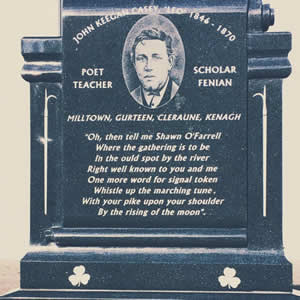
✍️ Lyricist: John Keegan Casey, (1846 - 1870) - Irish poet, orator and republican. After the Fenian Rising in 1867, he was imprisoned for 8 months due to his involvement in the Fenian Brotherhood. He wrote many popular songs including The Rising of the Moon (c.1865), Maire My Girl, Donal Kenny, Soggarth Aroon, and St Patrick's Day in the Morning.
Died at age 23 on St. Patrick's Day: Already weakened physically from the treatment he received in prison, he died from from the effects of consumption, compounded by injuries received when his carriage collided with a dray in the centre of Dublin. He was buried in Glasnevin Cemetery where tens of thousands of mourners walked in the funeral procession.
Other Title: Carroll Bawn
📝 Song Brief:
The song is set around the 1798 Wexford Rebellion - one of the many uprisings in which the Irish fought against the oppression and injustice inflicted upon them by their more powerful English neighbours.
It tells the story of Carroll, a young rebel who fought bravely by the River Slaney before being captured and executed. The song is narrated by the woman who loved him, describing his courage, his final moments, and the grief that follows his death.
📖 Glossary:- Carroll Ban
Bán (pronounced 'fawn' in some dialects, but usually 'bawn') means white or fair-haired in Irish. It's a term of endearment for a handsome young man. - gibbet
A gallows-type structure used for public executions. - pike
The primary weapon of the 1798 rebels; a long wooden shaft with a sharp iron spearhead. - Mo bhron — My Grief or My Sorrow
- Mo chroi — My Heart
- "O fhior ghear that ever I saw that dreadful sight"
the singer is describing a "piercing grief" or a "bitter sorrow." It refers to the physical and emotional "hurt" of seeing Carroll Bán in such a state (white-cheeked and damp-haired) before his execution. - Saxon - Englishman
- foemen — enemy
- Saxon foeman
This refers to the British forces (Redcoats). The line, "He fought the Saxon foeman by Slaney’s glancing wave," describes Carroll Ban physically standing his ground against the enemy at the water's edge. - Slaney
Refers to the River Slaney, one of the most significant rivers in the southeast of Ireland. - glancing wave
A poetic way of describing the sunlight reflecting or "glancing" off the moving water.
🍀 Genre: Irish Folk Song, Irish Rebel Song
👥 Covers: Jim McCann, Glasnevin, Terry O'Neill
🎤 Featured Artist: Jim McCann
💿 Album: By Request
Released: 2000
Country: UK
Format: CD
Label: Celtic Collections
Note: While many versions of this song exist, the lyrics provided here are based on the specific arrangement recorded by Jim McCann.
🌿 You may also like:
📖 References
- John Keegan Casey - Wikipedia
- Casey, John Keegan - Dictionary of Irish Biography
- Come and I Will Sing You: A Newfoundland Songbook by Genevieve Lehr, Univ of Toronto Press, 1985.