Ballad of James Larkin Lyrics
Christy MooreMusic Video
Ballad of James Larkin
In Dublin City in 1913
The boss was rich and the poor were slaves
The women working and the children hungry
Then on came Larkin like a mighty wave
The workmen cringed when the boss man thundered
Seventy hours was his weekly chore
He asked for little and less was granted
Lest getting little he'd ask for more
But on came Larkin in 1913
A mighty man with a mighty tongue
The voice of labour the voice of justice
And he was gifted and he was young
God sent Larkin in 1913
A labor man with a union tongue
He raised the worker and gave him courage
He was their hero, the workers son
In the month of August the boss man told us
No union man for him could work
We stood by Larkin and told the boss man
We'd fight or die but we would not shirk
Eight months we fought and eight months we starved
We stood by Larkin through thick and thin
But foodless homes and the crying children,
They broke our hearts and we could not win
Then Larkin left us we seemed defeated
The night was black for the working man
But on came Connolly with new hope and counsel
His motto was that we'd rise again
In 1916 in Dublin City
The English soldiers, they burnt our town
They shelled the buildings and shot our leaders
The harp was buried beneath the crown
They shot McDermott and Pearse and Plunkett
They shot McDonagh and Clarke the brave
From bleak Kilmanham they took their bodies
To Arbour Hill to a quicklime grave
But Last of all of the seven leaders
I'll sing the praise of James Connolly
The voice of labour the voice of justice
Who gave his life that men might be free
Song Details
✍️ Writer: Donagh MacDonagh (1912 - 1968) - poet, playwright, judge, presenter, broadcaster and balladeer.
The History of the Ballad
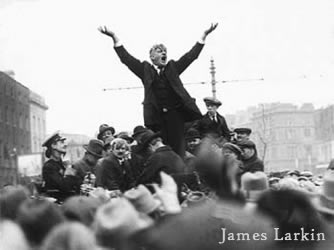
Big Jim Larkin and the 1913 LockoutThe song is about James Larkin, an Irish trade union leader and socialist activist best known for his role in the 1913 Dublin Lockout. The conflict eventually concluded in early 1914 after calls by Connolly and Larkin for a sympathetic strike in Britain were rejected by the British Trades Union Congress.
Although the movement was unsuccessful in achieving immediate better conditions and pay, it established the principles of union action and workers' solidarity in Ireland.
James Connolly and the 1916 Legacy
After Larkin's departure for America, James Connolly took the lead, defending workers from the frequent brutality of the Dublin Metropolitan Police. Connolly became the driving force behind the 1916 Easter Rising, aimed at ending British rule and establishing an independent Irish Republic.
The sacrifice of Connolly and other rebel leaders played a significant role in shifting public opinion and gathering the support for the movement they died fighting for.
📖 Glossary: Leaders Executed After the Easter Rising
- James Connolly (1868–1916)
A socialist leader, trade union organiser, and commander of the Irish Citizen Army. Connolly was one of the central figures of the Easter Rising and a signatory of the Proclamation. Severely wounded during the fighting, he was executed while strapped to a chair in Kilmainham Gaol, becoming one of the Rising’s most enduring symbols of sacrifice. - Thomas MacDonagh (1878–1916)
A poet, teacher, and one of the signatories of the Proclamation of the Irish Republic. He served as a commander during the Easter Rising and was executed in Kilmainham Gaol. - Patrick Pearse (1879–1916)
A teacher, writer, and central leader of the Easter Rising. He read the Proclamation outside the GPO and became one of the most symbolic figures of the rebellion. Executed in Kilmainham Gaol. - Joseph Plunkett (1887–1916)
A poet and strategist who helped plan the Rising. He famously married Grace Gifford in Kilmainham Gaol just hours before his execution. - Seán Mac Diarmada (1883–1916)
Often anglicised as McDermott, he was a key organiser of the Easter Rising and one of the seven signatories of the Proclamation of the Irish Republic. Deeply involved in the IRB, he helped plan the rebellion and was executed in Kilmainham Gaol for his role.. - Thomas Clarke (1858–1916)
The oldest of the signatories and a lifelong revolutionary. Widely regarded as the spiritual father of the Rising. Executed in Kilmainham Gaol..
🍀 Genre: Political / Irish Folk Song
👥 Covers: Ronnie Drew, The Dubliners, Mark'S Men, Paddy Reilly.
🎤 Featured Artist: Christy Moore
💿 Album: Paddy on the Road
Released: 1969
Country: UK
Format: 12" Vinyl
Label: Mercury
Related Songs on this Site:
- Banna Strand - A ballad recounting the failed 1916 attempt to land German arms on the Kerry coast to support the Rising.
- Bold Fenien Men - A tribute to the Fenian movement, celebrating the courage and determination of Irish rebels who fought for independence.
- Erin Go Bragh - A song of Irish identity and defiance, often associated with resistance to British rule and the spirit that fed into the Rising.
- Grace - A moving love song telling the story of Grace Gifford and Joseph Plunkett, who married in Kilmainham Gaol hours before his execution in 1916.
- James Connolly - A powerful tribute to the socialist leader of the Easter Rising, honouring his bravery and final sacrifice.
- Kevin Barry - A ballad about the young IRA volunteer executed in 1920, remembered as a martyr whose story echoes the sacrifices of 1916.
- Patriot Game - A reflective, questioning song about a young volunteer drawn into the struggle for Irish freedom, inspired by the legacy of the Rising.
- Tri Coloured Ribbon - A song celebrating the Irish flag and the pride, hope, and sacrifice associated with the fight for independence.